By Kevin Roberts
Last time we discussed what heat is. If you haven’t already, you should read that one first.
There are many ways to remove heat from inside of a box to outside a box. You could get a large container of ice, put it in the box, wait for it to melt, then replace it with more ice. We had one to these in the farmhouse I was raised in. It’s called (quite creatively) an ice box. We could do that in an automobile but it’s labor intensive, messy, and it adds to the inside humidity.
What we want is a system that functions with the driver simply operating the controls, not the driver performing the heat removal.
In order to do that we need a system that uses energy as necessary, sourced from the prime mover, either the internal combustion engine fuel tank or the EV battery.
For an HVAC system to remove heat from inside the vehicle to outside the vehicle efficiently, you need the following:
- A refrigerant. This is the medium that we transfer heat to (while inside the box), and transfer the heat from, (while outside the box). In an ice box, the water/ice is the refrigerant. We transfer heat from the inside of the box to the ice by melting it into water, and then literally dump the water outside the box. Thereby removing the heat with the water.
- A sealed system with a fixed volume. This will be used to contain the refrigerant. You can’t allow any of the components to expand like a balloon.
- A balance between the two above. This is important and will be covered in the next article.
Now we turn to the necessary components. They not only need to be part of the system, they need to be in the correct order in the refrigerant circuit. We start with the pump:
- A pump. To compress the refrigerant, and to move the refrigerant through the system.
- An external heat exchanger. This will transfer the refrigerant vapor heat of compression to the external atmosphere. We call it a condenser.
- A restriction in the system beyond the external heat exchanger and just before the internal heat exchanger. This performs one role with two results.
First, as a restriction, it allows the compressor to build pressure. Without the restriction, the compressor would simply be a pump with a slight pressure increase at the outlet that would be dissipated in the circuit as the refrigerant returns to the inlet.
Second, it allows for a distinct high pressure side and low pressure side of the circuit.
- An internal heat exchanger. This will transfer the heat from the box (henceforth passenger compartment) to the refrigerant in the system. We call this component an evaporator.
- A storage unit to hold a varying amount of excess refrigerant. How much depends on many external variables.
- Hoses and hard lines to connect the components together. These allow for a circuit of refrigerant flow.
In addition to all these components, we need:
Proper airflow across the heat exchangers. It is hard to overstate the importance of airflow. The lack of airflow is a common cause of ineffective cooling.
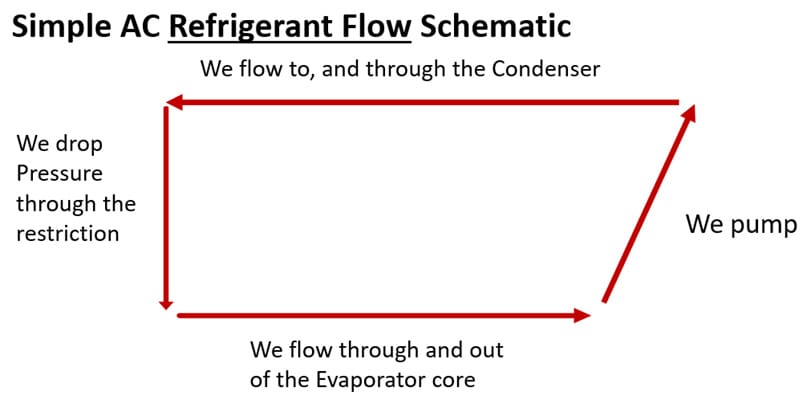
Figure 1
Now is a good time to pause and reread the above list. These components are your HVAC team and if any one of them pulls a hamstring, you are going to have to figure out which one. The limp might not be obvious.
The pump is our compressor. What does a compressor do? Oddly enough, it compresses. To anyone familiar with hydraulics, experience has taught us that some fluids compress and some do not. Vapors do. Liquids do not. If you feed liquid to a compressor, it makes funny noise. “Cha-ching,” the sound of money being spent. As the compressor operates, it compresses the vaporized refrigerant and by doing so, compresses the heat contained in the vapor, thereby raising the temperature. It also adds a certain amount of heat through the compression process.
What do heat exchangers do? They exchange heat from one medium to another. The condenser transfers the heat generated by the compressor from the refrigerant into the atmosphere. The evaporator transfers heat from the passenger compartment into the refrigerant.
The duty of the HVAC Tech when wearing his maintenance hat, is to have a clear understanding of each component and to inspect for anything that would impede its function.
The duty of the HVAC Tech when wearing his diagnosis hat, is to determine which of these team members is falling down on the job. If he can regularly do so before he hooks up the gauges, he is an above average Tech.
The duty of the HVAC Tech when wearing his repair hat, is to avoid rushing through certain parts of the repair process that are as exciting as watching paint dry.
We will cover all these duties in detail in future articles.
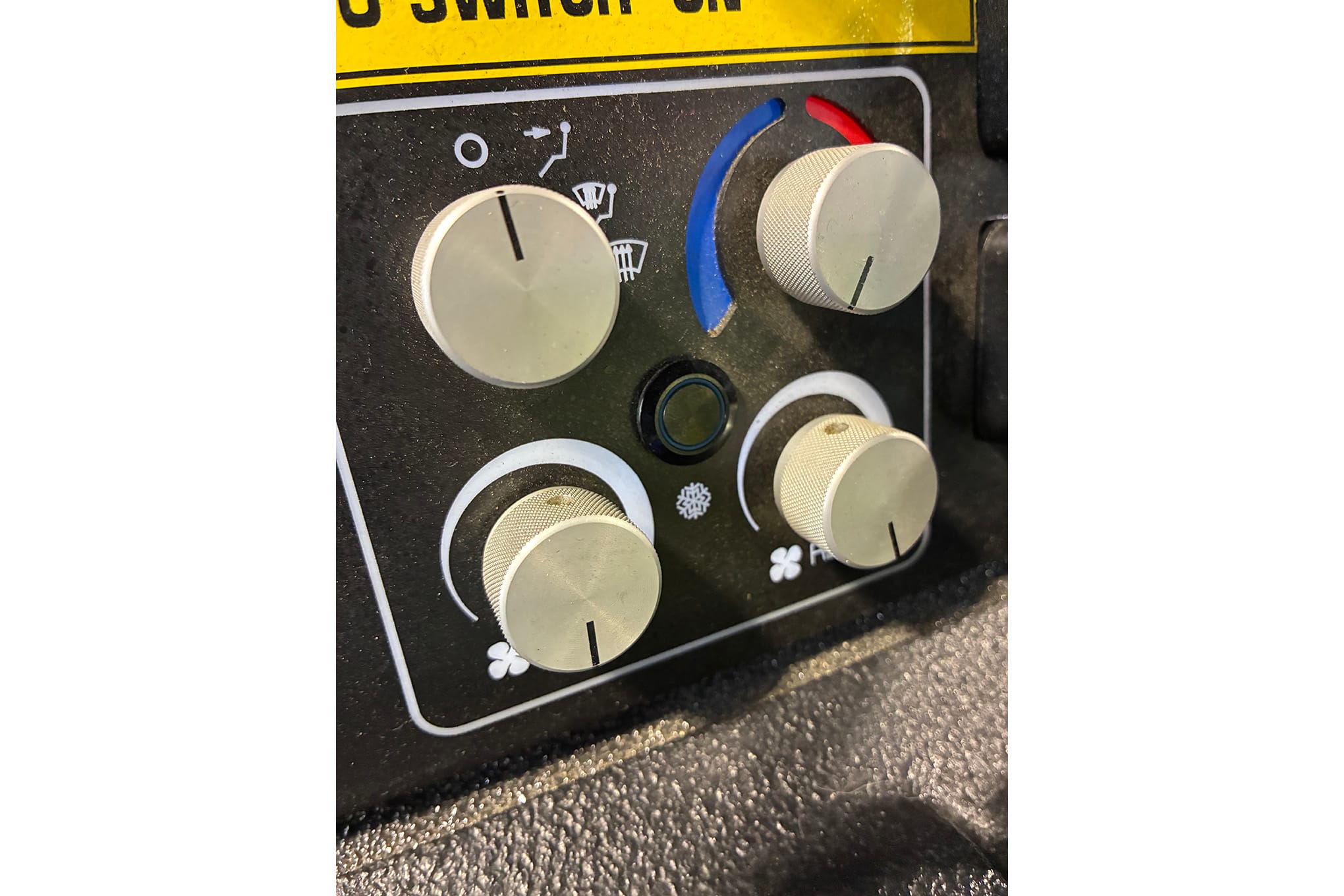
To build an HVAC system that allows the operator to control cabin temperature with 2 or three knobs takes a lot of components. All of these must work together seamlessly.