In the first article on apparatus HVAC systems, I mentioned that latent heat disappears. Disappearing does not mean that the heat ceases to exist. It simply means that we cannot measure it through our normal means—a thermometer. As mentioned in that article, I write “You can add heat without changing the temperature,” on the whiteboard in the classroom whenever I lead an HVAC class. This is latent heat. We are all familiar with the concept. You find beads of sweat on your forehead. As it evaporates, it draws heat from the environment, in this case your forehead, thereby cooling your forehead without necessarily warming the sweat. We add heat to the sweat and change its physical state to vapor. Essentially, the heat from your forehead boils the water, and it takes heat from your forehead to do so.
Heat that you can measure with a thermometer is referred to as “sensible heat”.
Making use of the principle latent heat is what makes an HVAC system efficient.
When we compress the refrigerant vapor, we concentrate the existing heat into a smaller volume and add a small amount of heat as well. This is measurable as sensible heat by the resultant temperature change. Why? Because we changed a low-pressure low-temperature vapor into a high-pressure high-temperature vapor. If no change of state is accomplished, there is little or no latent heat. Stop and read that again. Without change of state, we do not make use of latent heat.
Consider a glass of ice water. We can add heat to the contents without changing its temperature. The liquid maintains a stable average temperature until the last remnants of ice melt. Then the temperature will rise. Understanding this principle is key to understanding an HVAC system.
This temperature stability is also true of water on a stove. Once we achieve the boiling temperature, we can add heat without changing the temperature, we simply use the heat to change the 212°F water into 212°F steam. Instead of raising the temperature, we are changing the ratio of one state of matter to another state of matter. In the first case it is ice to water and in the second case, it is water to steam.
In the HVAC system, we change the ratio of vapor to liquid in the condenser and the ratio of liquid to vapor in the evaporator. This is where the efficiency of heat removal resides: The ability to change state.
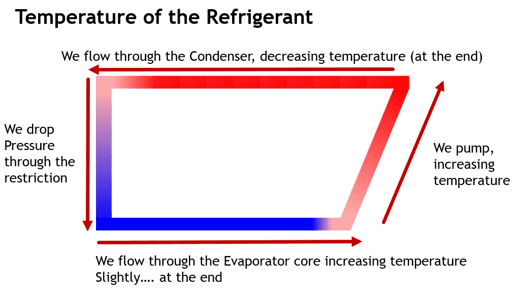
While and where both liquid and vapor coexist, there will be no temperature change from the additional heat. In the case of the condenser, once the vapor is fully changed to liquid, any heat added will now be sensible heat and can be measured with a thermometer. By comparing the inlet and outlet temperatures of the condenser, we can see if the vapor has fully condensed into liquid. If the outlet temperature is lower than the inlet temperature, full condensation has occurred. This principle allows us to “see inside” a closed system. If we see that temperature drop at the outlet of the condenser, the number of degrees of that temperature drop has a name. It is called “subcooling”.
The operation of the compressor places a constant, but pulsed, pressure on the high side of the system. This pressure is not simply a force against the outer walls of the fixed volume system. It is a dynamic pressure on the inlet side of the Thermal Expansion Valve (TXV). By dynamic, I mean that maintaining the pressure difference is dependent on a working compressor to support it. This TXV contains a variable orifice that allows for a pressure drop between its inlet and outlet that maintains pressure against the inlet and allows the pressure to drop passed its outlet. This pressure drop leads to expansion of the liquid refrigerant as it converts back to a vapor. The process of evaporation draws heat from the environment (similar to the way adding heat causes water to boil). Some HVAC technicians prefer the term “boiling” over “evaporation” when describing what goes on in the evaporator core. You can think of it both ways:
- Adding heat to the liquid leads to boiling.
- Boiling (due to the pressure drop) leads to the adding of heat to the liquid to make it vapor.
At startup, the heat is removed from the warmer refrigerant inside the evaporator. This is quickly depleted so the temperature drops rapidly, cooling the metal evaporator. This, in turn, draws heat from the air being blown past it. As the refrigerant flows through the evaporator, it does so as combination of liquid and vapor. The evaporation begins at the outlet of the TXV and continues until just before the outlet of the evaporator. Here we have a process similar (but reversed) to that of the condenser. Where and while we have a combination of liquid and vapor, we have no temperature change even with added heat. Once the evaporation is complete and we have vapor only, and any heat added will now change the temperature of the refrigerant. This change in temperature can be measured by the number of degrees that the refrigerant exceeds the boiling/vaporization temperature. And it has a name. It is called superheat.
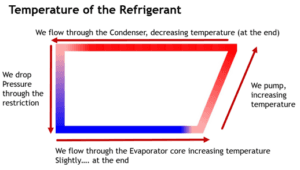
The shape of this graphic is intentional and will be discussed in future articles. For now, simply understand that the two horizontal lines refer to our two heat exchangers. The top one is the condenser. The bottom one is the evaporator. It is within these two components that we find liquid and vapor coexisting. Therefore, if we add or subtract heat from either of these, we simply change the ratio of liquid to vapor. We need to use the latent heat principle but only in the heat exchangers. This is one of the reasons we need all the components in the system to be balanced with all the others. If we send a mixture of liquid and vapor (no superheat) to the compressor, we can destroy it. If we send a mixture of liquid and vapor (no subcooling) to the TXV, we lose efficiency and may have warmer air than desired from the vents, and unhappy drivers.
Next time: the function of the TXV.