The Sea Isle City (NJ) Fire Department covers a one-by-four-square-mile area with a year-round population of 40,000 that swells to 100,000 in the summer on the Atlantic coast barrier island of Ludlam Island. The department runs a Sutphen rescue-pumper, a Spartan ER pumper, a Ferrara 77-foot aerial ladder quint, a water rescue truck, a Zodiac rigid-hull inflatable (RIB), and a Yamaha WaveRunner from one station that’s staffed by 22 full-time and 43 part-time paid stipend volunteer firefighters.
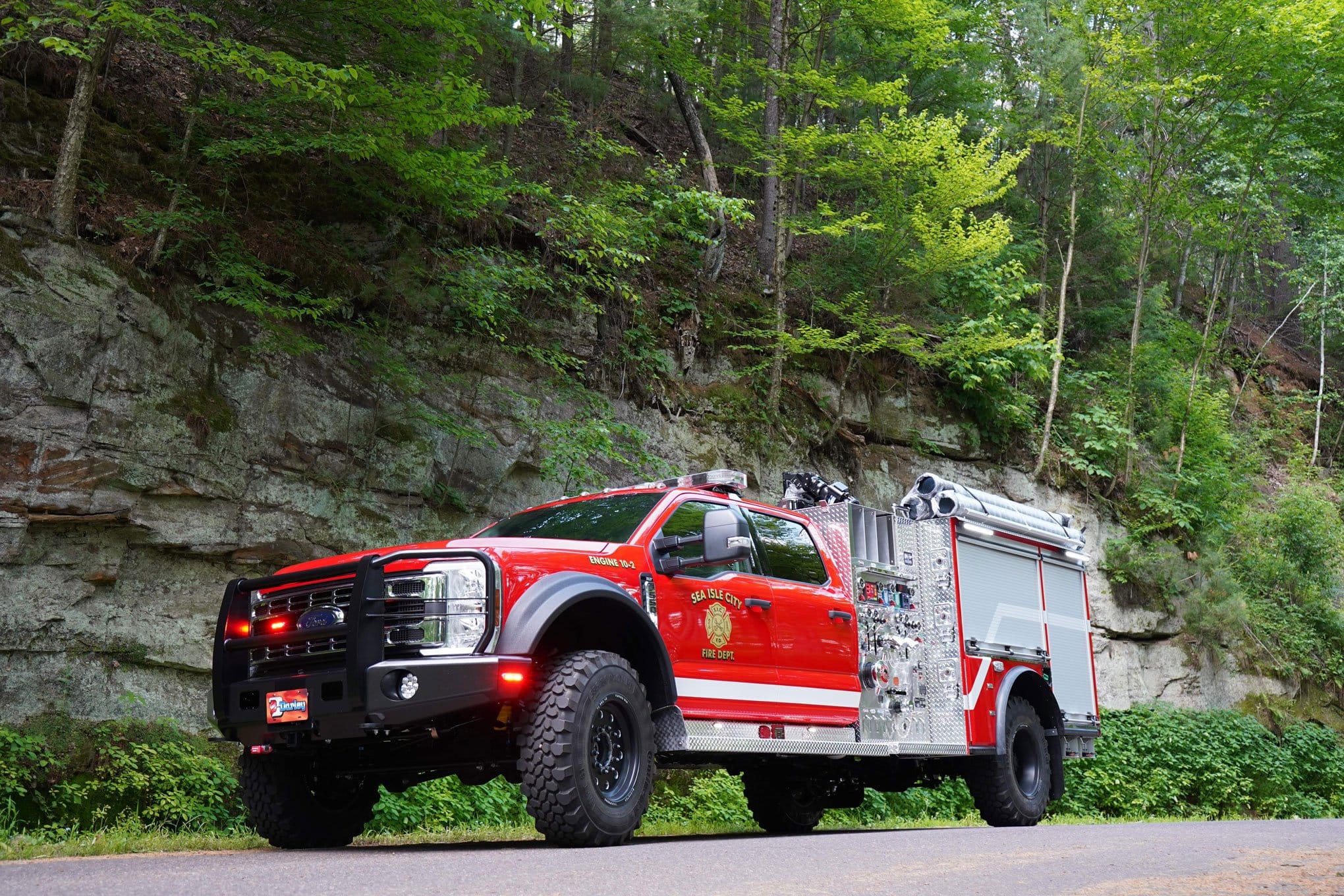
Sea Isle City determined it needed a more nimble vehicle than its Type 1 pumpers to negotiate some of the tight areas of the town, as well as to access residents during flooding and high water. The department chose Darley to build it a Max Tactical Pumper™ to fill that slot in its fleet.

Chief Joe Wagner says the department bought the tactical pumper to complement its first-due engine and to better handle high water situations. “We got the tactical pumper with Super Single wheels and tires and used it this summer when a hurricane was off the coast,” Wagner points out. “We were able to take that tactical pumper through four feet of flood water and make a series of rescues with the vehicle.”
Kyle Darley, vice president of Darley’s tactical division, says the Max Tactical Pumper that Darley built for Sea Isle City is on a Ford F-550 four-door 4×4 cab and chassis with seating for four firefighters, two of them in self-contained breathing apparatus (SCBA) seats, a PolyBilt™ copolymer body, a 330-horsepower (hp) 6.7-liter engine, and an OEM automatic transmission. Wheelbase on the tactical pumper is 203 inches, overall length is 26 feet 4 inches, and overall height is 8 feet 10 inches.

Darley says the Max Tactical Pumper has a Darley PSMC 1,500-gallon-per-minute (gpm) midship pump, a 300-gallon water tank, a 25-gallon foam tank, a Darley AutoCAFS® compressed air foam system (CAFS) with a gear-driven 120-cubic-feet-per-minute (cfm) compressor, and a FoamPro 2001 foam proportioner.
“The Max Tactical Pumper has a lift package that increases ground clearance for better off-road capability,” Darley observes, “and the Super Single wheels and tires also provide better ground clearance and improve off-road traction.” He notes that the rig has an all stainless steel plumbing package, maintenance-free mechanical seals, a Kussmaul battery charger with Super Auto Eject, and a heavy duty custom front bumper with driving lights, a brush guard, a two-inch receiver and a Warn portable winch.

Wagner points out that all the tactical pumper’s hoselines and discharges are CAFS-capable, while a Task Force Tips (TFT) Typhoon deck gun that flows only water. “The hoselines on the pumper include one 2½-inch hose crosslay of 150 feet, two 1¾-inch hose crosslays of 150 feet each, a 200-foot 2½-inch hoseline preconnected in the hosebed, and an electric booster reel holding 150 feet of 1-inch hose in the rear compartment. The hosebed is carrying 600 feet of 5-inch large-diameter hose (LDH).
Darley adds that the department has storage for five 30-minute SCBA cylinders in the R1 compartment, Performance Advantage Company PacTrac on the rear wall swing-out tool boards in the L2 and R2 compartments, a 2½-inch autofill valve at the rear of the rig, three eight-foot sections of hard suction on the top left side of the body, and an Alco Lite three section 20-foot extension ladder, 8-foot roof ladder, and 8-foot attic ladder nested on top of the right side of the body.


ALAN M. PETRILLO is a Tucson, Arizona-based journalist, the author of three novels and five nonfiction books, and a member of the Fire Apparatus & Emergency Equipment Editorial Advisory Board. He served 22 years with the Verdoy (NY) Fire Department, including in the position of chief.