The Big Horn County (MT) Rural Fire District has three stations and covers 5,023 square miles, a huge swath of territory in the south central part of the state, with a population of 13,000 residents.
Fire Chief and Roads Superintendent AJ Espinoza says the station in Hardin, Montana, houses three Type 6 wildland/brush pumpers, two 1,500-gallon tenders, two 6,000-gallon tenders, two bulldozers, and several road graders. The station in Decker, Montana, has one 3,000-gallon tender, one Type 6 wildland/brush pumper, and two road graders, he adds, while the station in Lodge Grass, Montana, has one Type 6 wildland/brush pumper and two road graders.

“We had two outdated fast-attack pumpers that were handling our structure fire calls, along with our Type 6 pumpers,” Espinoza says, “and after we received a grant for a new engine, we went to Darley to discuss having them build us a Max Tactical Pumper that could handle structure fires, wildland fires, and motor vehicle fires, as well as rescue work.”
Kasey Roan, Big Horn County’s deputy chief, says he and Espinoza saw Darley’s Max Tactical Pumper online and, after checking out its attributes, contacted Darley directly to work out the specs for a rig for their department. “Our Type 6 pumpers have always been dual-use rigs for both wildland and structure fires,” Roan points out.

“With the new pumper, we wanted it to have more punch for structure fire calls as well as to be able to deal with wildland fires and other types of incidents,” Roan says. “It also was important that the rig have a bumper turret and front bumper sprayers, a foam system, and also be four-wheel drive so we could take it off road and have it negotiate muddy lanes and long, difficult driveways.”
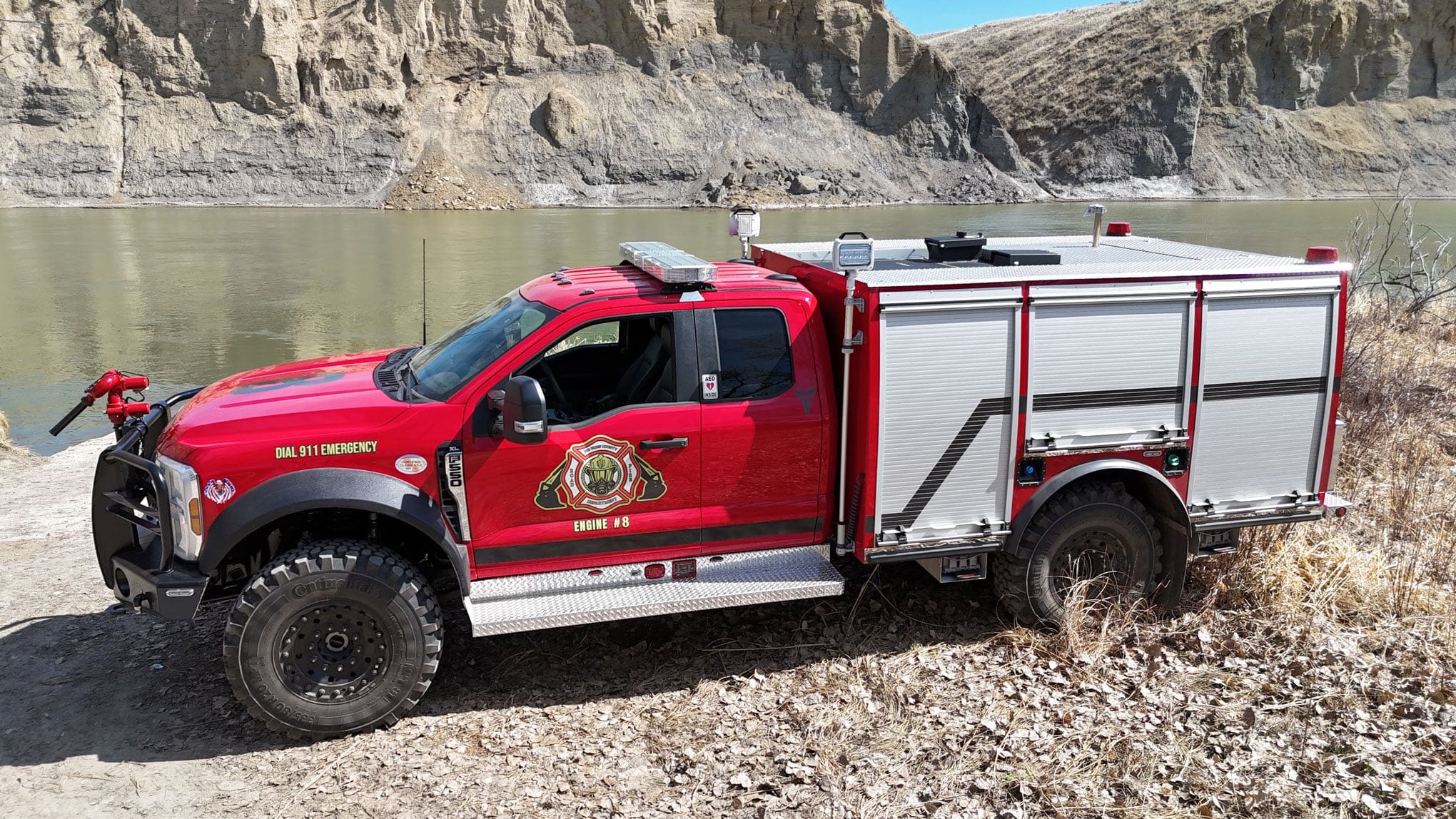
Kyle Darley, vice president of Darley’s tactical division, says the Max Tactical Pumper is built on a Ford F-550 extended cab and 4×4 chassis with seating for four firefighters with a PolyBilt® copolymer body, all stainless steel plumbing, and Continental 335/80R 20 tires. Wheelbase on the tactical pumper is 168 inches, overall length is 25 feet 1½ inches, and overall height is 7 feet 9 inches.

Darley notes that the Max Tactical Pumper has a Darley 2BE rear-mount pump, a 24-horsepower (hp) Kubota diesel engine that can do pump-and-roll operations, an Odin Mongoose Compressed Air Foam System (CAFS), a 400-gallon copolymer water tank, and a 25-gallon foam cell. He adds that the pump’s water performance delivers 250 gallons per minute (gpm) at 40 pounds per square-inch (psi) and 120 gpm at 100 psi, and the CAFS flow is 46 gpm at 23 cfm and 125 psi discharge pressure.
Darley says the rig has a 12-VDC electric primer system, a 2½-inch National Pipe Thread (NPT) inlet, a 2½-inch discharge, a 1½-inch discharge, an electric hose reel in the R3 compartment holding 100-feet of 1-inch booster hose, an Elkhart Brass BrushHawk remote-controlled bumper turret plumbed for CAFS, under-front-bumper spray nozzles, and a 2½-inch direct tank fill.

Espinoza notes that the top of the L1 and R1 compartments on the rig are transverse with enough room for a Stokes basket, backboard, and long-handled tools. Four self-contained breathing apparatus (SCBA), two each are in the L2 and R2 compartments. Battery-powered rescue tools are in the lower R1 compartment, and hand tools and spare SCBA cylinders are in the L3 compartment.
Lighting on the Max Tactical Pumper includes a Whelen 60-inch LED lightbar, Whelen LED warning lights, a Whelen LED traffic advisor, FRC Spectra LED telescoping scene lights on the front of the body, underbody LED lighting, and LED lighting on the rear folding steps.
ALAN M. PETRILLO is a Tucson, Arizona-based journalist who has served as a newspaper reporter, editor, and magazine writer and is a member of the Fire Apparatus & Emergency Equipment Advisory Board. He served 22 years with the Verdoy (NY) Fire Department, including in the position of chief.