Photo by Chris Mc Loone.
BY KEVIN ROBERTS
Last time, we left you hanging with a dilemma. How can we measure the same quantity using area [pounds per square inch (psi)] on the one hand, and length (in Hg) on the other hand. If you have not read that one, you should.
The short version is that psi (force divided by area) is what pressure is. Inches of mercury is what pressure does.
For this we will need some pictures.
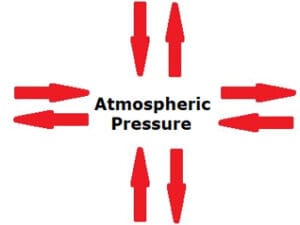
Figure 1. (Figures by author.)
Figure 1 shows what pressure is and how it is exerted in all directions. Remember that we live at the bottom of an ocean of air called an atmosphere. This ocean presses itself against us from all sides. Because we will compare the water ocean with the atmosphere, it may take a little work to keep them straight.
The reason the atmosphere presses against us is because it is a fluid that has mass. If there was something displacing a portion of the atmosphere whose weight was equal to the weight of the displaced air, that something would float. Think of a balloon filled with exactly the correct amount of helium so that the lightness of the helium balances the weight of the balloon itself so that together, they equal the weight of that volume of air. Read that again if you need to. You will need this to understand what is coming.
At the bottom of this ocean of air, at standard temperature (68°F), an open container of water stays liquid. As you raise the elevation of the container of water, the atmospheric pressure drops. This means that the boiling point of that water drops as well. If the pressure drops enough, the water will boil at 68°F. So, what do we know so far? This ocean of air creates the atmospheric pressure that we experience, it keeps water liquid, varies in pressure with altitude, and provides air flow into an idling engine when the throttle is opened.
If the needle on your pressure gauge is at zero at sea level, you are reading “gauge pressure.” If the needle is at 30 in Hg or 14.7 psi, you are reading “absolute pressure.” To illustrate, you could take a narrow glass tube with one closed end 36 inches long and fill it with mercury. You could then hold your thumb over the open end and then invert the glass tube placing the open end into a dish of mercury. If you then hold the glass tube perfectly vertical, and remove your thumb, the level of mercury at the top will drop until it reaches just about 30 inches above the level of the mercury in the dish. The pressure of the atmosphere can support about 30 in Hg at sea level. The empty space above the mercury is essentially a vacuum, with an absolute pressure of zero. Evangelista Torricelli did this for the first time in 1644, and we know it as the first barometer. The weight of the atmosphere is balancing the weight of the mercury in the tube. This is why we use mercury. A water column would have to be 33.8 feet tall to do be supported by the atmosphere in a measurable manner.
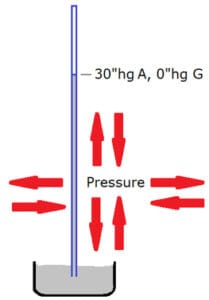
Figure 2.
Figure 2 shows what pressure does by balancing the height and pressure of the atmosphere to a 30-inch-tall column of mercury. This shows the equivalence of a 1-square-inch column of mercury to a 14.7-pound weight. Even though this figure shows a 1-square-inch column of mercury, the diameter of the barometer isn’t critical (for the barometer). The height of the column will be the same. A 1-square-inch column provides the same pressure as a ¼-square-inch column. The pressure (force/area) depends only on the height of the column. If you were to measure the pressure per ¼ square inch, you would find atmospheric pressure at 3.675 pounds per ¼ square inch, and Figure 3 would show a ¼-square-inch column on the left and a 3.675 weight on the right.
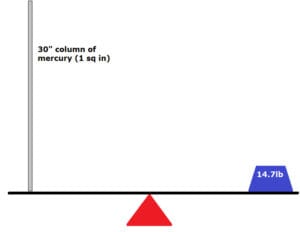
Figure 3.
The reason it does this is because a 30-inch-tall, 1-square-inch column of mercury weighs 14.7 pounds. This balances with a 1-square-inch column of atmosphere, which is roughly 62 miles tall and gets less dense the higher you go.
To evacuate the system, we need to drop the pressure to about 0.0098 psi, this is what the pressure is. Instead of supporting the height of the column of mercury at 30 inches, it supports a column of mercury about 500 microns tall. This is around 0.020 inch or 20 thousandths of an inch tall. This is what the pressure does. This is why a micron gauge is recommended for measuring proper vacuum in an HVAC system. Clearly, you cannot read an analog gauge accurately at this small amount of pressure. If you can’t read the pressure precisely, you depend on three things:
- Your vacuum pump.
- Time to properly evacuate the system.
- This is similar to hammering wheels on without a torque wrench. Count the impact gun “ka dunk a dunks” and hope.
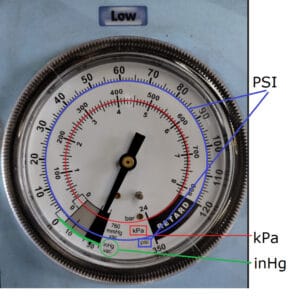
Figure 4.
Figure 4 shows the low side gauge on a Robinair 34788 RRR machine. Notice the range between atmospheric pressure and 30 in Hg is very small. Also notice the psi, kPa, and bar ranges. Finally notice that here, kPa is measured in gauge pressure, not absolute pressure. We usually measure pressure in psi on both the high side and low side unless evacuating and then we measure it in in Hg negative. Do you need a micron gauge? That is an economic decision, but if you are conscientious as well as under time constraints, you may find that a micron gauge saves time by avoiding either over pumping to be on the safe side or just hoping that you get enough of the air out.
Next time, latent heat.
KEVIN ROBERTS is president of the EVT Certification Commission