In the first article of this series about heat and HVAC systems, I asked the question: “How do we get heat from inside a box to outside a box?” This sounds like work — and that is exactly what it is. Work.
First, a little terminology. Work is: “The transfer of energy from one physical system to another, especially the transfer of energy to a body by the application of a force that moves the body in the direction of the force. It is calculated as the product of the force and the distance through which the body moves.” (Source: American Heritage Dictionary of the English Language).
The short version of that is that work equals force times distance. If I move two pounds of weight a distance of one foot, I have done two foot-pounds (ft-lb) of work. (If I perform that amount of work by rotation rather than in a straight line, we call that “torque” and measure it in pound-feet, or lb-ft.)
I clearly remember my 8th grade physics teacher pushing against the classroom wall and telling us that because the wall didn’t move, he hadn’t actually done any work. Needless to say, this made an impression on me. So, if I have to move sixty pounds of sand from inside a box to outside a box, and I move the sand one foot at a time, I have accomplished sixty foot-pounds of work. If it takes me an hour to do so, I am doing one foot-pound per minute.
The rate at which work is done has a name: we call it “power.” These units of power also have a name: we call them “watts.” If we wrap our heads around this, other things start to make sense. Another unit for power is horsepower; 746 watts equal one horsepower. If we are removing heat instead of sand, that rate has a name as well: “British Thermal Units (BTUs) per hour.” (1 watt = 3.41 BTU/hour.)
So, if your work is done by lighting an RV, we call the rate watts.
If we are cooling the RV, the rate is BTUs per hour.
If we are pulling the RV up a hill, the rate is horsepower.
Each of these measures the rate of doing work. The work alone is force times distance; the rate of doing the work includes the time factor.
So, let’s talk about moving heat.
If I have a closed cylinder containing air, that cylinder also contains heat. The amount of heat can be measured in BTUs. The intensity of the heat is measured in degrees. (For today, we will use the Fahrenheit scale.)
What needs to be understood is that the amount of heat is not the same as the temperature. An iceberg contains more heat than a pot of boiling water at the same altitude.
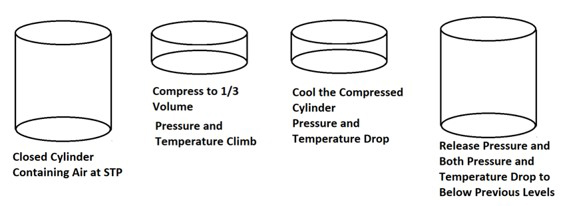
Back to the closed cylinder. What happens if we compress the air in that cylinder? We concentrate the existing heat into a smaller volume, which drives the temperature up. If we then relax the pressure by returning to the original volume, the temperature returns to what it was before (see Figure 1). We can manipulate the temperature of a gas by compressing it.
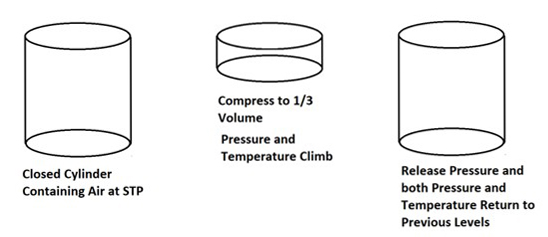
Steps to manipulate the temperature of air through compression.
In that diagram, STP means “standard temperature and pressure” which in our case is 32°F and one bar (14.5 pounds per square inch, or PSI). The most important takeaway is that lowering pressure, if done at the same rate, lowers temperature. That is not quite as intuitive as raising pressure raises temperature.
Now, simply manipulating the temperature in a closed cylinder doesn’t answer our question of how to remove heat from a box. To do that, we need to go further.
If we follow the steps in Figure 2 — concentrate the heat in the cylinder by compression, then cool the cylinder, then lower the pressure in the cylinder — we find that the temperature is now lower than when we started. Read that sentence again. Read it as many times as you need to.
Steps to manipulate the temperature and pressure of air in a closed cylinder, resulting in both dropping below previous levels.
First, understand that:
Compression→ heats and decompression → cools to original temperature.
Then, understand that:
Compression → heats, cooling → cools, decompression → cools below original temperature.
That is Principle One of the Magic of Air Conditioning.
Principle Two adds the Magic of Change of State which involves more heat transfer (see Figure 3).
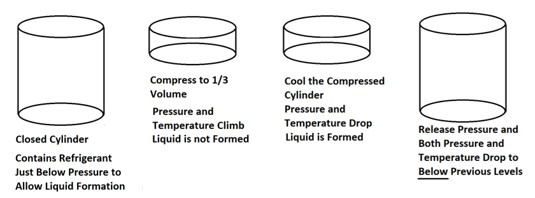
Steps to initiate heat transfer: vapor is pressurized to increase its heat, then cooled so it condenses.
By compressing a vapor, we concentrate its existing heat. This raises the temperature. The compressor sends that hot vapor to the first heat exchanger called the condenser.
When we cool that high pressure vapor, it condenses onto the inner surface of the condenser. This is performed while that same compressor maintains pressure. Normally, cooling of a pressurized vapor would cause the pressure to drop (static system). But we have a dynamic compressor. This is slightly different from the above Figure 3 which is an idealized view.
The flow of refrigerant through the condenser meets the flow of air around the tubes of the condenser, and it is at this meeting that heat is exchanged (Figure 4).
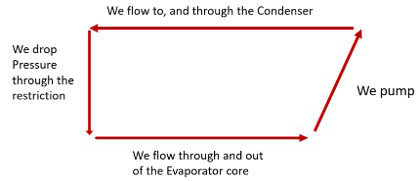
Simplified AC refrigerant flow schematic.
What we have covered in this, and the previous article about latent heat, is the pumping of the vapor, flowing it through the condenser, and how the pressure is maintained by compressor action pushing the vapor into the condenser that in turn sends it to the restriction. Since there is air flow past the tubes of the condenser, heat is exchanged, and the loss of heat from the refrigerant causes the vapor to condense so that the restriction device flows liquid only.
This is the first half of the cycle simplified. We concentrate the heat from “inside the box” containing the refrigerant through compression. We then send that heat to the environment, “outside the box,” through the heat exchanger called the condenser.
Next time we will discuss the second half of the cycle, also simplified, to show the reverse exchange of heat from the “inside the box” ambient air into the refrigerant.
KEVIN ROBERTS is the president of the Emergency Vehicle Technician Certification Commission (EVTCC).