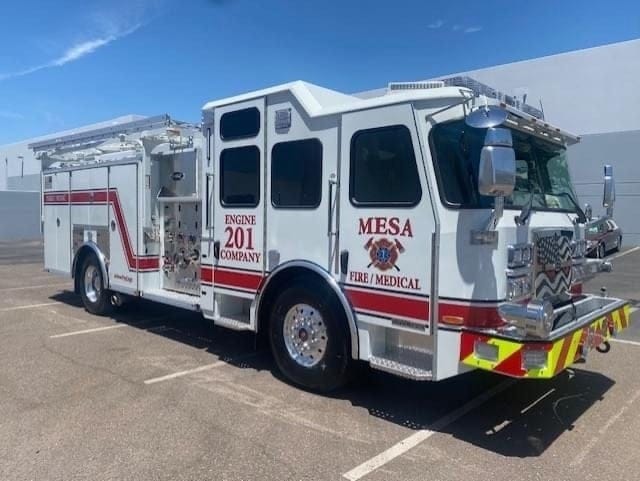
Over the past six months, the Mesa (AZ) Fire and Medical Department has received and put in service 11 E-ONE Cyclone custom clean cab pumpers that are spread out among its 22 fire stations to protect the city’s half-million residents in its 138-square-mile coverage area.
Jason Nickelson, fire maintenance administrator for Mesa Fire and Medical, says the department had two major requirements of the new pumpers—a clean cab concept and a Cummins X12 engine. “We decided to go with the 500-horsepower (hp) Cummins X12 with an Allison 4000 EVS transmission because we wanted to be sure the pumpers had enough torque and power, especially when we have to take them out of town on automatic mutual aid calls where there are a lot of hills and other steeper topography,” Nickelson points out.

Mark Julien, vice president of sales for Fire Truck Solutions, who sold the E-ONE Cyclone engines to Mesa, says the department got what it wanted with the clean cab, as well as the power plant and transmission, powering a Cyclone four-door cab and 4×2 chassis that’s set up to carry five firefighters in USSC Valor Magnus seats with a custom-built tool compartment at the back of the crew cab, accessible from the exterior on each side of the rig.
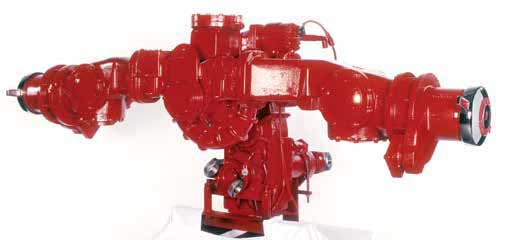
Julien notes that the rigs each have a 1,500-gallon-per-minute (gpm) Waterous pump with the pump panel having pistol grip pump control levers, a 500-gallon water tank, a 30-gallon foam tank, and a FoamPro 2002 foam proportioning system. Wheelbase on the rigs is 194 inches, overall length is 34 feet 4 inches, and overall height is 10 feet 2 inches.

Nickelson points out that using the clean cab concept, the department located the crew’s self-contained breathing apparatus (SCBA) on each side of the rigs. “The officer’s side of the pumpers is the clean side of the rigs, and we do not carry any fireground tools on that side,” he says. “There are three SCBA secured in the R2 compartment, the captain’s turnout gear and a cooler in the R1 compartment, and emergency medical services (EMS) equipment and a refrigerator for pharmaceuticals that must be kept cool in the R3 compartment.”
He adds that the driver’s side of the rigs has the engineer’s turnout gear in the L1 compartment, two SCBA and tarps in the L2 compartment, and hand tools and irons in the R3 compartment.

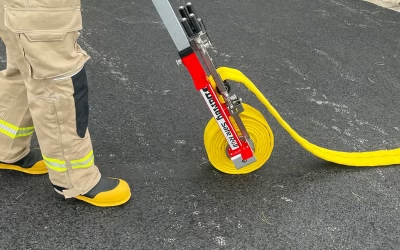
In terms of a hose complement, Julien says the pumpers have two 200-foot 1¾-inch crosslays, one 200-foot 2½-inch crosslay, and 150 feet of 1¾-inch hose in the extended front bumpers. He adds that the hosebeds carry 800 feet of 5-inch large diameter hose (LDH), 300 feet of dead lay 1¾-inch hose, and two 200 foot dead lays of 2½-inch hose. The rigs have 200 feet of one-inch redline hose on electric hose reels and manual Elkhart Brass 1,250-gpm deck guns with Stream Shaper nozzles on top of Task Force Tips (TFT) Extend-A-Guns.
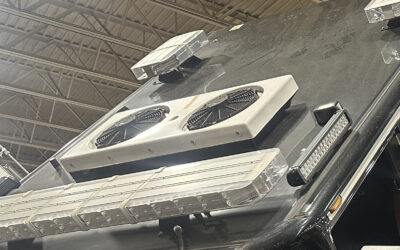
Julien says the rigs also have Federal Q2B sirens on the front bumpers, dual-arm hydraulic ladder racks on the top right side of the rig, Whelen LED emergency lighting, a Whelen Freedom IV LED lightbar, and HiViz FireTech LED scene lighting with photocells to dim the rig’s lighting during nighttime hours so as not to blind oncoming traffic or firefighters on the scene.

ALAN M. PETRILLO is a Tucson, Arizona-based journalist, the author of three novels and five nonfiction books, and a member of the Fire Apparatus & Emergency Equipment Editorial Advisory Board. He served 22 years with the Verdoy (NY) Fire Department, including in the position of chief.