Your station tones alert: “Engine 86, Engine 260, Ladder 29, Car 32: Respond to 15 Smith Street. Report of a fire in a private dwelling with multiple calls reporting people trapped.” You have trained your body. You have trained your mind.
Up to this point, you have attended training and performed drills to prepare for this very emergency. But, how often do you think about the readiness of your apparatus? Without a properly maintained, fully functional, and safe apparatus, you will fail to meet the mission statement of the fire service to protect lives and property. The best trained firefighters and officers will quickly be rendered useless if they cannot safely and effectively respond to the given emergency. If their apparatus does get them to the scene, will it be able to pump the water correctly, power the aerial device, or power the rescue tools they need to accomplish their mission? By now, you are hopefully asking yourself, is my apparatus fit for duty?
Fire apparatus are some of the most complex, customized, and expensive vehicles on the road today, with so many different systems and components that all require regular maintenance to operate correctly at a moment’s notice. Let’s not forget the fact that they live a life of mostly hard miles, hard acceleration, hard braking, responding and returning, and endless hours of stationary running time with the constant loads of numerous onboard systems to run on scene.
After reviewing National Fire Protection Association (NFPA) 1911, Standardfor the Inspection, Maintenance, Testing, and Retirement of In-Service Emergency Vehicles (now NFPA 1910, Standard for the Inspection, Maintenance, Refurbishment, Testing, and Retirement of In-Service Emergency Vehicles and Marine Firefighting Vessels), you will need to implement a system to maintain your fleet with preventive maintenance schedules and regular checks to recognize problems before they leave you unexpectedly out of service. Ensure pumps, aerial devices, and portable ladders receive the necessary annual testing. The nature of the fire service is to be always ready, always alert. Establish measures to ensure your apparatus are always ready for the next response.
To be an effective fleet manager, you must be proactive. You need to ensure you have regular and thorough apparatus checks that are documented. Use a repair facility specializing in fire apparatus and implement at least a six-month and annual preventive maintenance schedule to have the vehicle inspected from bumper to bumper. If your call volume warrants it, you may have to implement a three-month preventive maintenance schedule based on engine hours and response volume. All apparatus components should receive preventive maintenance and inspection service according to the manufacturer’s recommendations for that given component. Brakes, tires, steering, suspension, lights, and all other safety components must be inspected for defects to ensure firefighter safety. If you are not already doing so, consider issuing an apparatus safety inspection annually by your respective state’s heavy vehicle inspection station, the same as every other truck on the road. Fire departments may not be required to complete this, but it gives you an extra measure ensuring the vehicle has been inspected for safety.
No matter how much preventive maintenance you do, problems will arise that will require a repair outside of your regular maintenance schedule. Two of the most common difficulties in reporting the defects include members not seeing anything getting fixed and giving up and not having a good system of reporting problems. Often, members will not want to lose their front-line apparatus and must change over to a spare or be down an apparatus. As a fleet manager, come up with a system that is efficient and easy for you and your members. Address reported problems in an effective manner so members don’t feel like their reports are falling on deaf ears. When members see progress, they are more likely to help with solutions.
I always like to use the three Cs when dealing with repairs: complaint, cause, and correction. Have an efficient means of reporting complaints: email, software, paper, or phone call. Have a good means for documenting and tracking information like fire department/fleet management software or email. Verify the complaint before you send it to the repair center so you don’t waste time and money if there is no real problem or if the problem can be easily corrected in house. When verifying the complaint, you should work to determine the cause of the problem. This may not happen until the apparatus is at the repair facility. Gather as much information as possible and speak with the member making the repair request or other familiar apparatus operators. When addressing intermittent or condition-specific defects, the more information you supply the service writer, the more efficient he can be at pinpointing the condition and cause.
Prioritize your repairs and address the most important ones first. Safety-related items such as a brake lining worn past specification will take priority over a scene light that may be out. Lastly, there is the plan of correction, which is usually determined by the recommendation of the repair facility or in-house technician. Formulate a plan and determine lead times for parts and any other special considerations or recourses that may be needed for the repair. Often, apparatus can sit for weeks waiting for a part that would not put the apparatus out of service. This can be avoided with planning, prioritization, and good communication with repair facilities.
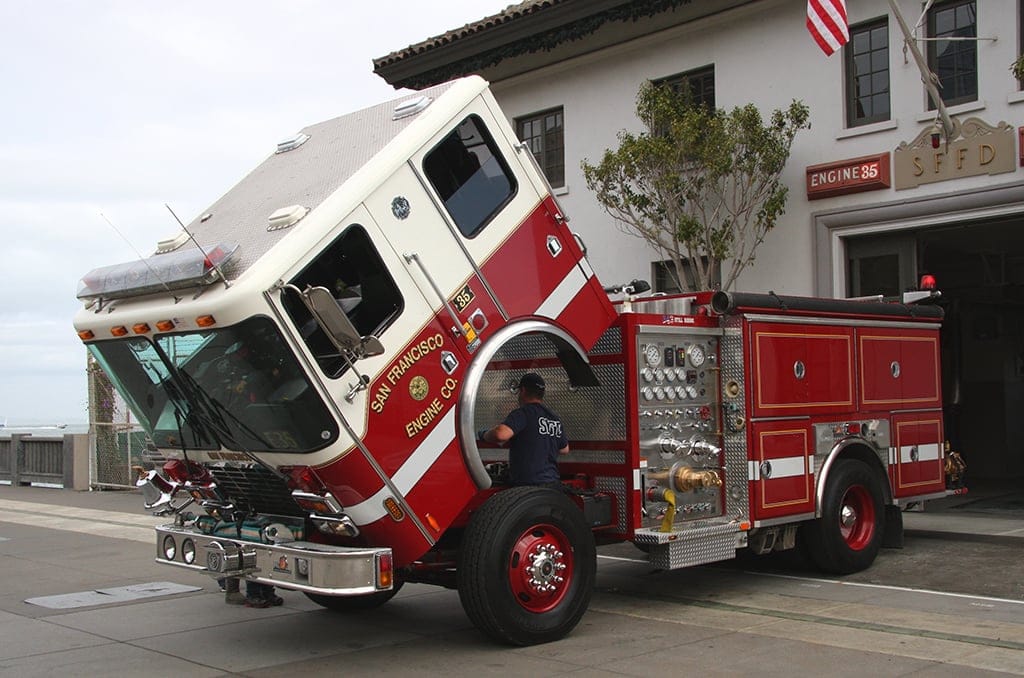
1 Photo by yanchi1984/Shutterstock.com.
Every department will have different means of handling fleet repairs and maintenance. Some have in-house mechanics. Others send everything to an independent repair shop or apparatus dealer. Some use their local department of public works highway garage. When dealing with any of the above repair facility options, use technicians who are National Institute for Automotive Service Excellence (ASE) and emergency vehicle technician (EVT) certified. Firefighters are required to maintain set levels of training; apparatus technicians should be no different.
Quality repair shops will always want the trucks to come to the shop for complete preventive maintenance and big repairs. If possible, save the road service for emergencies and minor repairs. Access to all the heavy shop equipment, vehicle lifts, tools, parts, and resources needed to repair fire apparatus is limited when working out of a service truck. Have a plan in place to send trucks to repair centers when needed or scheduled. The department usually pays for the travel time the technician spends driving to and from the apparatus location. It is far more beneficial to pay the same labor rate to have your apparatus repaired vs. the technician driving. There is a major benefit to working with a repair facility that is also a dealer for the apparatus you are operating. Warranty claims are handled more efficiently, and the facility and technicians are much more familiar with your brand of apparatus and have access to factory resources. Parts accessibility, lead time, and inventory are far better. This results in a much more efficient process because you are working with the people who best know your product.
I have three fundamental rules when dealing with any repair shop: (1) I don’t want to be misled or misinformed, (2) I don’t want to be sold anything I don’t need, and (3) I expect a shop to stand behind its work. This, unfortunately, is not always the case, so do your research on the repair facilities you are considering. Repair facilities’ reputations are very similar to those of the firehouse. It takes years to build a good reputation and a second to ruin it. Establish a repair contract with a quality shop so prices are set ahead of time, and you can minimize any surprises. This also makes billing easier for purchasing policies.
It is no secret that today’s fire apparatus are the most expensive pieces of equipment departments will have to purchase. Therefore, it should not come as a surprise that they are expensive to repair and maintain. The “pay now or pay a lot later” adage applies to maintaining and repairing fire apparatus. You must constantly invest the time and money in your fleet to make sure it is always operating at peak efficiency. If you take shortcuts, you will have shortfalls. There is no time to call AAA roadside assistance for your fire truck when responding to an emergency.
If you have an apparatus failure because you neglected to perform the correct preventive maintenance or repair, you have failed your firefighters and your community. Firefighters depend on functional and safe fire apparatus to be operationally effective and accomplish their mission of protecting lives and property.
RESOURCES
Emergency Vehicle Technician Certification Commission. www.evtcc.org.
National Institute for Automotive Service Excellence. www.ase.com.
National Fire Protection Association. NFPA 1911, Standard for the Inspection, Maintenance, Testing, and Retirement of In-Service Emergency Vehicles, www. nfpa.org.
JOHN COCKERILL has been a member of the Scarsdale (NY) Fire Department for 21 years and is a captain and fleet manager. He was previously head of fleet service at the Somers (NY) Fire District for six years (2016-2022). He has ASE Master Automotive Technician certification and EVT F1 certification for apparatus specification and F3 certification for fire pumps.