By Kevin Roberts
Before we can talk about safety, we need to address the principle of risk. On one level, risk is a practical synonym for life. The only people that do not incur risk are in their graves. So, now that we’ve expanded the audience to everyone capable of reading, let’s get into it.
A very wise man once told me that, “Risk is the balancing of probability with severity.” Probability is the likelihood of an occurrence. Severity is how bad the results will be, should the occurrence… occur.
Driving without a seat belt? Low probability, high severity. Walk through the living room in the dark with the kid’s toys strewn about? High probability, low severity.
When seen this way, we see risk all around us. Getting out of bed could lead to a slip and fall. Eating breakfast could lead to illness from improperly produced or packaged food. Driving to work may be risky for the other drivers. At work, accidents are serious enough to have a dedicated government bureau. Driving home, eating dinner, and getting into bed mimic the morning activity risks. And don’t forget that 15-20 percent of us will die on our sleep.
One of the goals in our industry is to minimize risk while still performing our duties. Don’t think that risk can be avoided. That is not an option. The only option is to exchange one risk for another. If you forget that basic principle, you find yourself playing Whac-A-Mole with unintended consequences. Mitigating risk in one area exacerbates risk in another. When you exercise, you risk injury. When you don’t exercise, you risk heart disease. When you incentivize your drivers to minimize the response time, to lower risk to the patient, you increase the risk to others on the public roadways.
In short, life is not a game of chess, it is a game of poker.
The key concept here is what you know. And when it comes to the future, you know very little. You don’t know if the guy at the stop sign is going to pull out in front of you. You don’t know if the guy behind you is going to slow down and stop while you are making a left turn across traffic. You don’t know if that one necessary part in your transmission was incorrectly approved by quality control and is about to break in the middle of a run.
The awareness of your lack of knowledge and of your responsibility to perform in the land of uncertainty is a mindset that must be cultivated. Both our culture and human nature lead us to drift into complacency.
When an emergency vehicle technician (EVT) is inspecting a rig, he must continually ask himself the question, “What if?” so that he may avoid asking the question, “What now?”
“What if” we postpone the replacement of the front pads and rotors? Will they survive until the next service? Asking this question now may avoid the “What now?” question after the truck breaks down (or worse) due to failed front brakes.
Due to many complex systems on the modern emergency vehicle, this may sound complicated and perhaps a bit overwhelming to a non-technician. However, it can be dramatically simplified saying, “Never do anything to an ambulance that you are not willing to explain to a jury.” (Nothing that follows should be construed as legal advice; that needs to come from an attorney)
Bad things happen every day, and you can’t know what they will be. First, the authority having jurisdiction (AHJ) must recognize the normal deterioration of mechanical systems to properly maintain the rig and prevent failures. Doing so lowers but does not eliminate risk. Second, he must provide evidence of proper maintenance. If, through no fault of the AHJ, the unforeseen occurs, not having the rig properly maintained will still get him in deep trouble because he will be investigated by an unfriendly attorney. That attorney’s goal is not to arrive at a just and proper result. His goal is to obtain a judgment against you. Juries may be subject to arriving at decisions that are more based on perception than reality, so any lack of due diligence on the AHJ’s part, even if they are not contributory to the “incident” at hand, can be used against him.
This is not a complaint, this is a simple statement of reality. You see, that attorney is no more omniscient than you are. He doesn’t know if you are a careful and conscientious manager or technician. So, not knowing causes him to evaluate whatever data he can find and arrive at a conclusion. Understanding this lack of omniscience allows us to recognize risk. Really? Realizing our lack of knowledge allows us to know something? Yes. It allows us to consider the knowns and unknowns which are at the heart of reality.
One of my favorite tools for evaluating two factor ideas is the Cartesian Plot with its two dimensional positive and negative layout as seen in Figure 1.
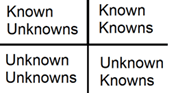
Figure 1
We see above four options. There are known knowns. These are our areas of expertise. There are unknown unknowns. These are concepts of which we are completely unaware.
This brings up the imbalance of knowing and not knowing. Your ignorance of the lower left can be absolute. But your knowledge of the upper right can never be absolute. The more you learn, the more you recognize the incompleteness of your understanding (if you possess humility).
Next, there are known unknowns. These are concepts in which we can (or should be able to) see the existence of even if we do not know when they will intrude into our reality.
Finally, there are the unknown knowns. These are things of which our System 2 (see the article: Making the Most of Practice Questions) is not fully aware. But below the surface, our System 1 is perfectly able to handle them. For example, you may have an imperfect key that you have trained yourself to use to open a lock. You find it easy to open that lock, but perhaps impossible to explain to someone else how to do so.
Let’s consider the upper left. These are the foreseeable but unknown risks that due diligence will prepare us for. The unruly driver, the overly litigious citizen, the faulty part in the transmission. How to properly prepare for these is an idea we must understand. This informs the distinction between real safety and liability safety which is where technician certification comes into play. But that will take another article.