The Palm Harbor Fire Rescue Department is in Pinellas County, Florida, located on the west central coast, known for its 35 miles of beautiful, sandy coastline on the Gulf. The county is part of the Tampa-St. Petersburg-Clearwater metropolitan area. With Tampa Bay sitting to the east, fire departments in the area see their share of boating and recreational incidents on all their waterways.
Palm Harbor Fire Rescue provides fire protection, advanced life support (ALS) medical service, hazardous materials mitigation, and marine rescue operations across a 20-square-mile area. The department operates out of four strategically located stations across its fire district, operating three ALS engines, an ALS ladder, an ALS heavy rescue unit, a brush/high water vehicle, and a marine unit. In addition, it operates as part of the countywide hazmat team with a Freightliner tractor pulling a Hackney walk-around trailer.

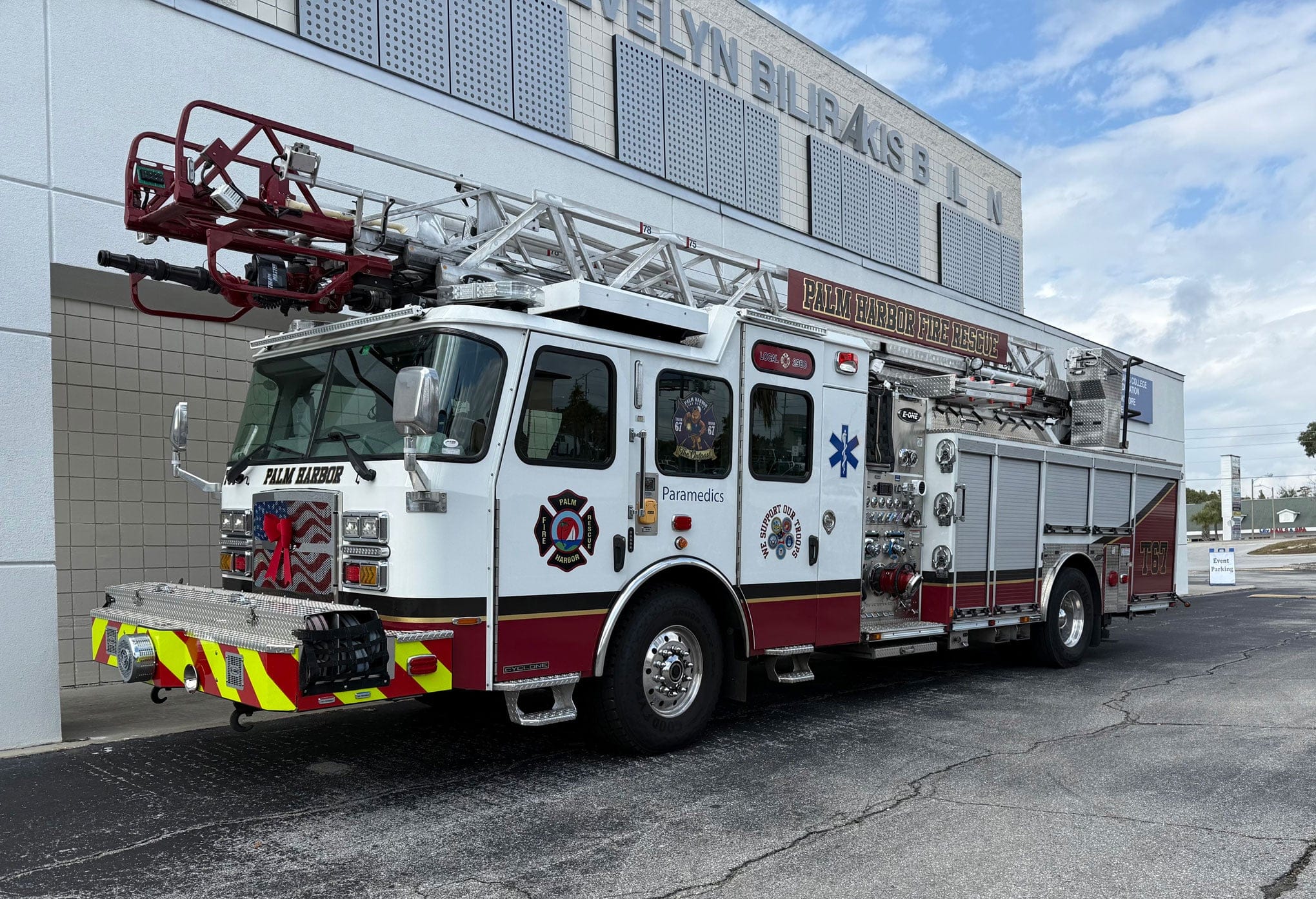
Station 67 serves the northeastern portion of the fire district and has the nickname, “The Outpost.” Three units respond from the location, Truck 67, a 2022 E-ONE Cyclone II HP78 aerial ladder; Brush 67, a 1996 Stewart Stevenson 4×4 light medium tactical vehicle (LMTV), which is also capable of high-water operations; and Rehab 68, a 1996 Ford F-350 utility vehicle.
Truck 67 sits on a Cyclone cab and chassis, which features E-ONE’s 78-foot, three section “Tough-Truss” extruded aluminum ladder. The ladder controls can also be run from the ground with a wireless control box. This feature can give the operator better visibility when placing the aerial ladder to its objective. With its short wheelbase and single set of jacks, it allows the unit to maneuver and set up in tight areas in the response district.

The rig has a Hale Qmax 2,250-gallon-per-minute (gpm) pump, a 500-gallon water tank, a Cummins ISX12 500-horsepower (hp) engine, and an Allison EVS 4000 automatic transmission.
With the pump, tank, and aerial ladder, the rig allows firefighters to perform engine and truck operations when called upon.

The truck’s cab and body are painted white with a small portion of the lower section being painted red. The red runs along the ROM roll-up compartment doors and extends upward on the rear compartment. Separating the two colors are a single black and gold reflective stripe.
Truck 67 is equipped with an extended front bumper, which has two hose troughs. In the hose troughs are two preconnected hoselines of 150 feet and 200 feet. An aluminum hatch cover protects these lines from the elements, and at the ends are safety straps to hold the lines in position during travel. There is a Federal Q2B siren, and two recessed air horns mounted inside the bumper. The bumper has DOT reflective striping for overall scene safety as does the rear of the rig.

To increase scene safety, a brow light is mounted above the windshield off the front of the apparatus. The cab also features two large vertical compartments behind each crew cab door that carry medical equipment and are easily accessible when disembarking the apparatus.
Since the “The Outpost” often operates alone for a period of time, this apparatus serves the department’s needs until other department units arrive on scene.


MICHAEL N. CIAMPO is a 39-year veteran of the fire service and a retired Lieutenant from the Fire Department of New York. Previously, he served with the District of Columbia Fire Department. He has a bachelor’s degree in fire science from John Jay College of Criminal Justice. He is an instructor for FDIC International HOT program. He wrote the Ladders and Ventilation chapters for Fire Engineering’s Handbook for Firefighter 1 & 2 and the Bread-and-Butter Portable Ladders DVD. He writes the back page column On Fire in Fire Engineering and is featured in Training Minutes truck company videos on FireEngineering.com. Recently, he wrote the textbook Tower Ladders, Tactics, Tips & Tales available at mikeciampo.com