
They’re called “West Coast” pumpers: KME’s K-180 program trucks that are ready for the road in 12 months and designed with a short wheelbase and overall length, a big pump, a low hosebed, and a rescue-style body. The San Bernardino County (CA) Fire Protection District just took delivery of 10 of these rigs, and likes them so much that they bought two additional demo units that were on the production line, and they’re going to order more K-180s.
Brandon Gomez, apparatus sales for Fire Apparatus Solutions, who sold the West Coast pumpers to San Bernardino County, points out that KME has several models of program trucks but they mostly favor the design of East Coast and Midwest pumpers. “We asked KME to let us design a program truck for the West Coast, specifically California, and they said okay,” he says. “So, we worked with San Bernardino County on a West Coast spec and came up with a rig to suit the needs of the majority of the fire departments in the state, with a list of optional features.”
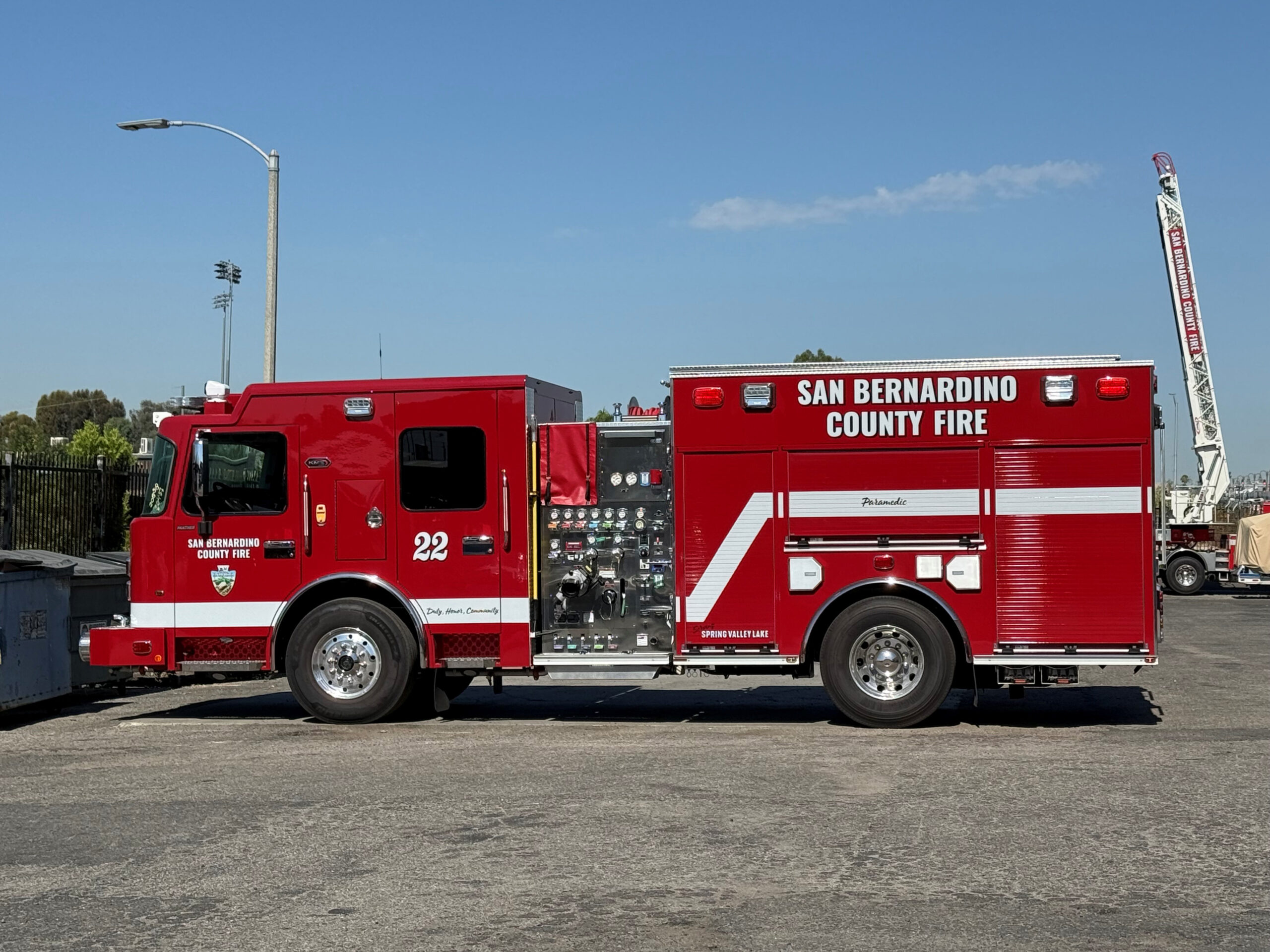
KME’s West Coast K-180 pumpers for the San Bernardino County (CA) Fire Protection District are program trucks that were delivered in less than 12 months. (Photos courtesy of the San Bernardino County Fire Protection District.)
Dale Sandoval, vehicle services manager for San Bernardino County Fire, points out that many of the departments in Southern California live and work in the same type of areas, and they all buy rigs with similar cabs and chassis, axles, transmissions, motors, pumps, and water and foam tanks. “KME’s K-180 program truck idea is brilliant,” he says. “For our West Coast pumper, we wanted a shorter wheelbase and overall length on the rig, a better angle of approach and departure, a 500-gallon water tank because most areas have a lot of hydrants, and a great air conditioning system. We found the KME AC system cools the cab down 30 degrees in only three minutes.”
Jake Virnig, KME’s director of sales, explains that the K-180 West Coast pumpers for San Bernardino County are built on a Panther extended medium four-door (EMFD) cab and chassis with a 10-inch raised roof and have seating for five firefighters in a clean cab concept and two emergency medical services (EMS) cabinets in the crew cab. They are powered by Cummins 450-horsepower (hp) X12 engines and Allison 4000 EVS automatic transmissions.
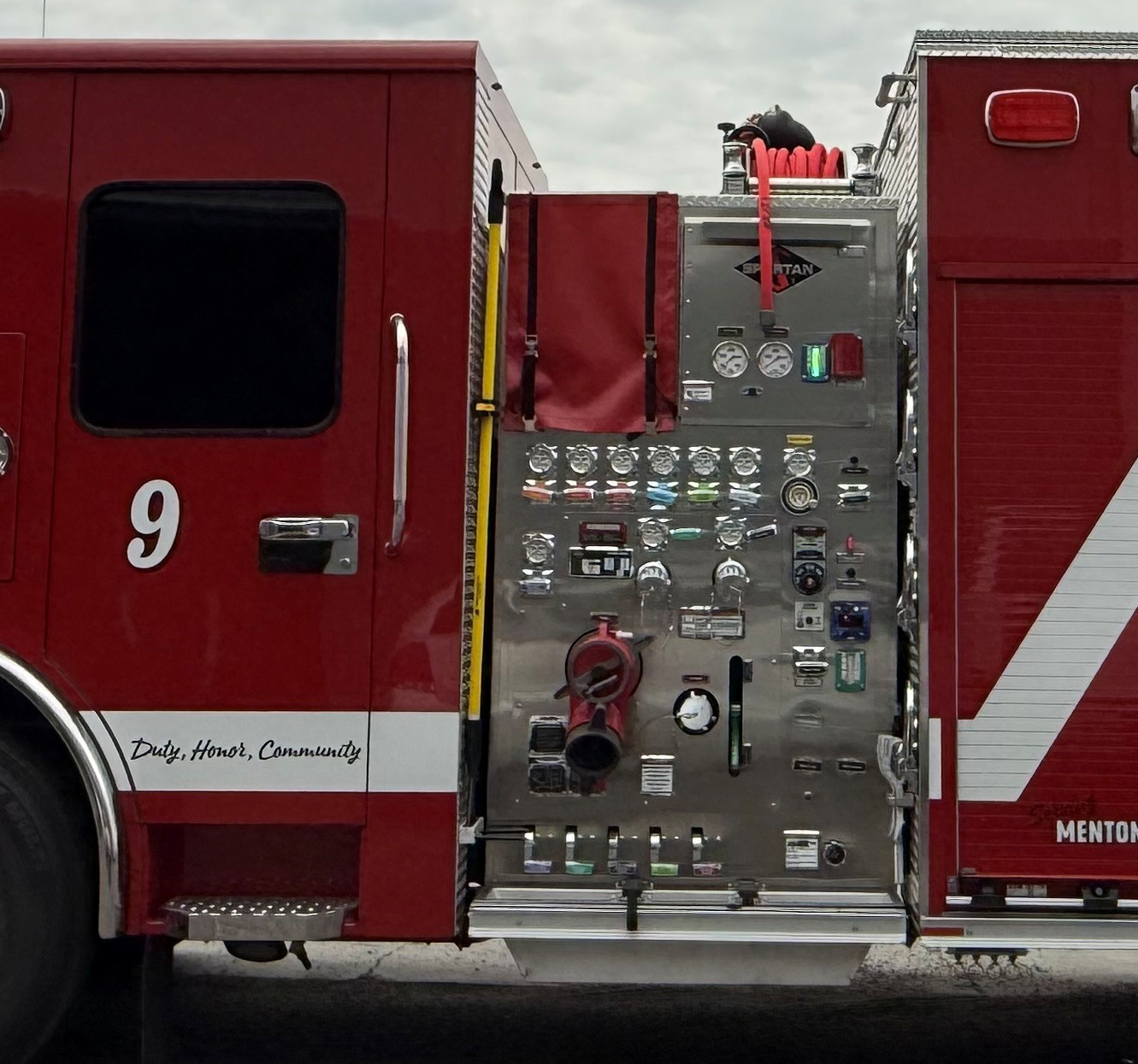
The K-180 pumpers have Waterous ESU 2,000-gpm pumps, 500-gallon water tanks, 20-gallon foam tanks, and FoamPro 2001 foam systems.
Virnig notes the West Coast pumpers have 149½-inch Tri-Max™ high-strength aluminum bodies on Vibra-Torque body mounting systems, ROM Series IV roll-up doors, high side compartments, storage for four self-contained breathing apparatus (SCBA) cylinders in the wheel wells, door protection shields, and four coffin compartments. Wheelbase on the rigs is 175 inches, and overall length is 28 feet 7 inches.
He says the San Bernardino County rigs have an extreme duty interior, IMMI 4Front® and RollTek™ occupant protections, FRC OmniPlex 10-inch touchscreen controls, a 12.8-inch touchscreen instrument cluster, and an Advanced Climate Control system. Other features include a Hendrickson STEERTEK NXT front suspension, a 20,000-pound front axle rating, a 24,000-pound rear axle rating, a 45-degree cramp angle, a 12½-inch heavy-duty steel front bumper extension, a Federal Signal Q2B mechanical siren, and Grover Stuttertone® air horns.
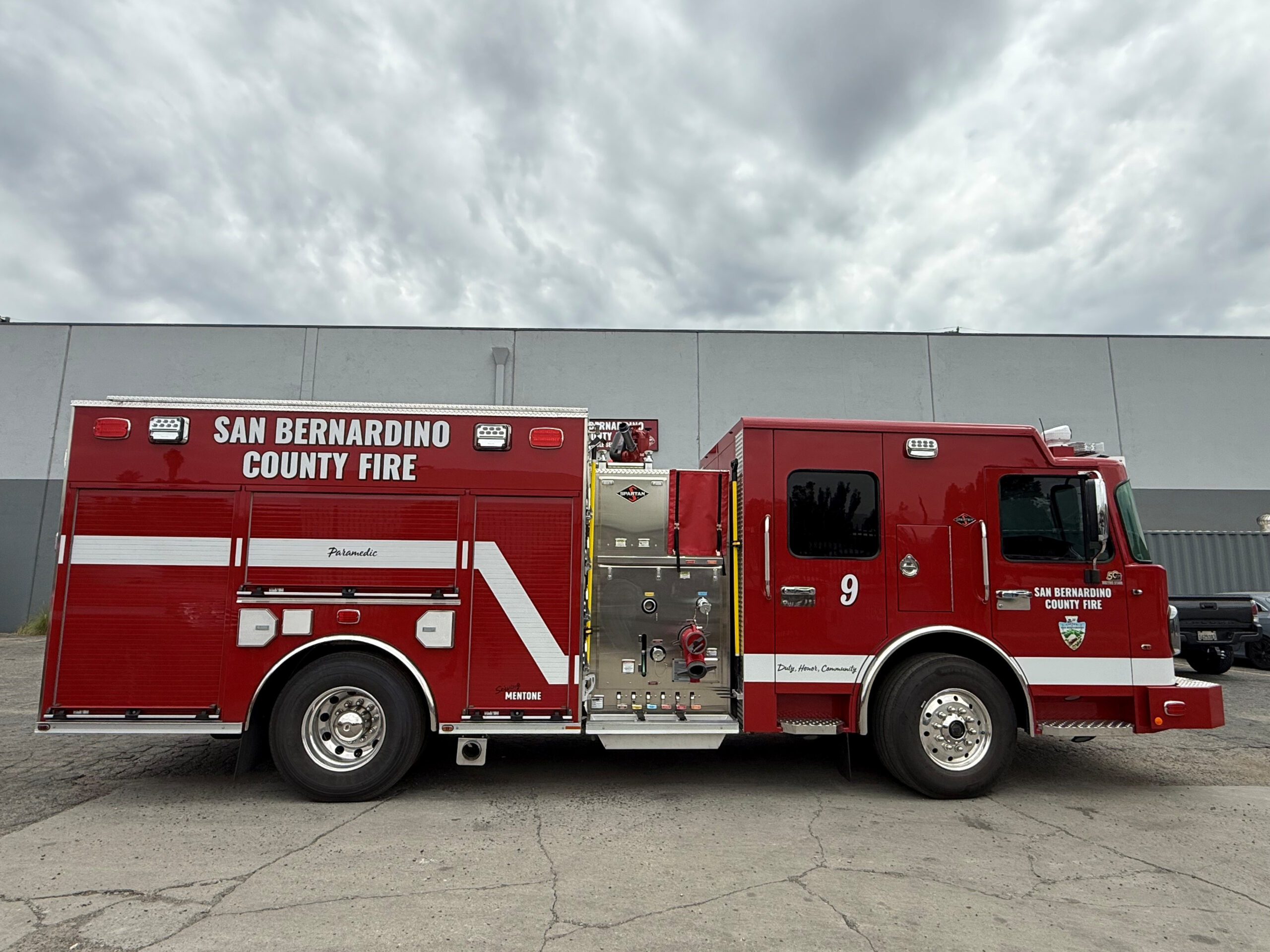
The San Bernardino County rigs are powered by Cummins 450-hp X12 engines and Allison 4000 EVS automatic transmissions.
Gomez adds that the rigs have Waterous ESU 2,000-gallon-per-minute (gpm) pumps, 500-gallon water tanks, 20-gallon foam tanks, and FoamPro 2001 foam systems. Each rig has two 200-foot 1¾-inch hose crosslays, 100 feet of 1¾-inch hose in a hose well in the extended front bumper, five 2½-inch discharges, one 4-inch discharge, and 150 feet of 1-inch booster line in an electric Hannay reel.
Two of the 2½-inch discharges are at the rear of the pumpers, where there also is slide-in covered ladder storage on each pumper for a two-section 24-foot extension ladder, a 14-foot roof ladder, and a 10-foot folding attic ladder, as well as a backboard and two pike poles. The low hosebeds are set up to hold 800 feet of 5-inch large diameter hose (LDH), 300 feet of 3-inch hose, and 300 feet of 2½-inch hose, and are covered by treadplate hosebed covers with integral rear directional lights.
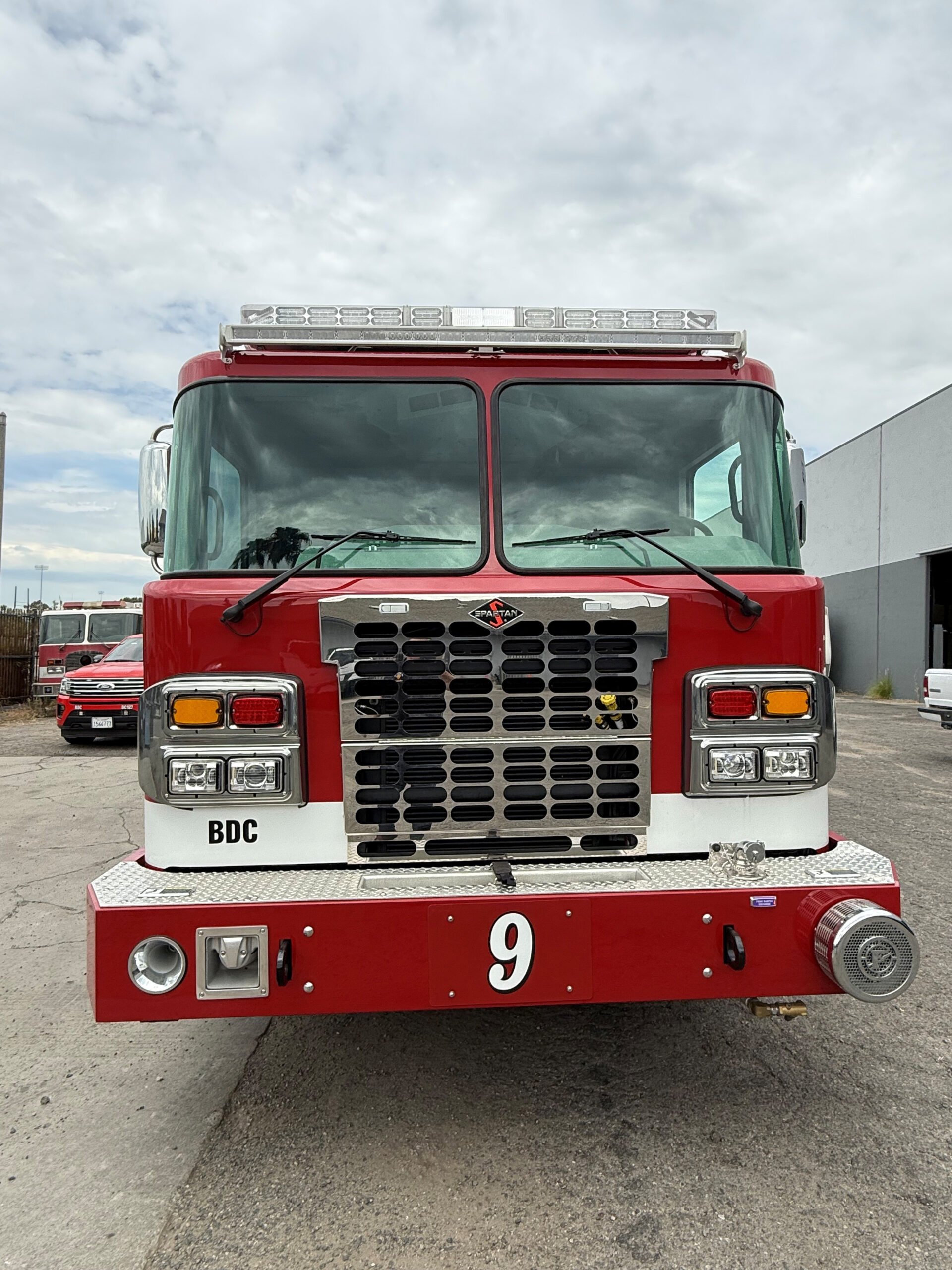
Lighting on the West Coast rigs for San Bernardino County includes Whelen LED warning and emergency lighting, Whelen Freedom IV LED lightbars, Whelen LED scene lighting, and OnScene Solutions LED compartment lighting.
Sandoval points out that the KME K-180 program trucks give a department 80% to 85% of the basic equipment common on fire apparatus, with the remainder of the equipment chosen from a list of options. “The fire service has to get away from some of its traditions,” he observes, “and the totally custom fire truck is one of them. If you can get a rig that’s 15% to 20% less than custom, get it delivered in less than 12 months instead of two years or more, it’s a quality product, and it still meets your department’s needs, why not choose that product?”
He says that the punch list on final inspection on the K-180s surprised him. “The largest punch list was 27 items, and that was on the first pumper,” Sandoval says. “That list went way down on the last 11 pumpers. In my experience, in a non-program truck, it would be 60 items or more. That tells me KME is building these trucks exactly the same in terms of quality and reliability.”
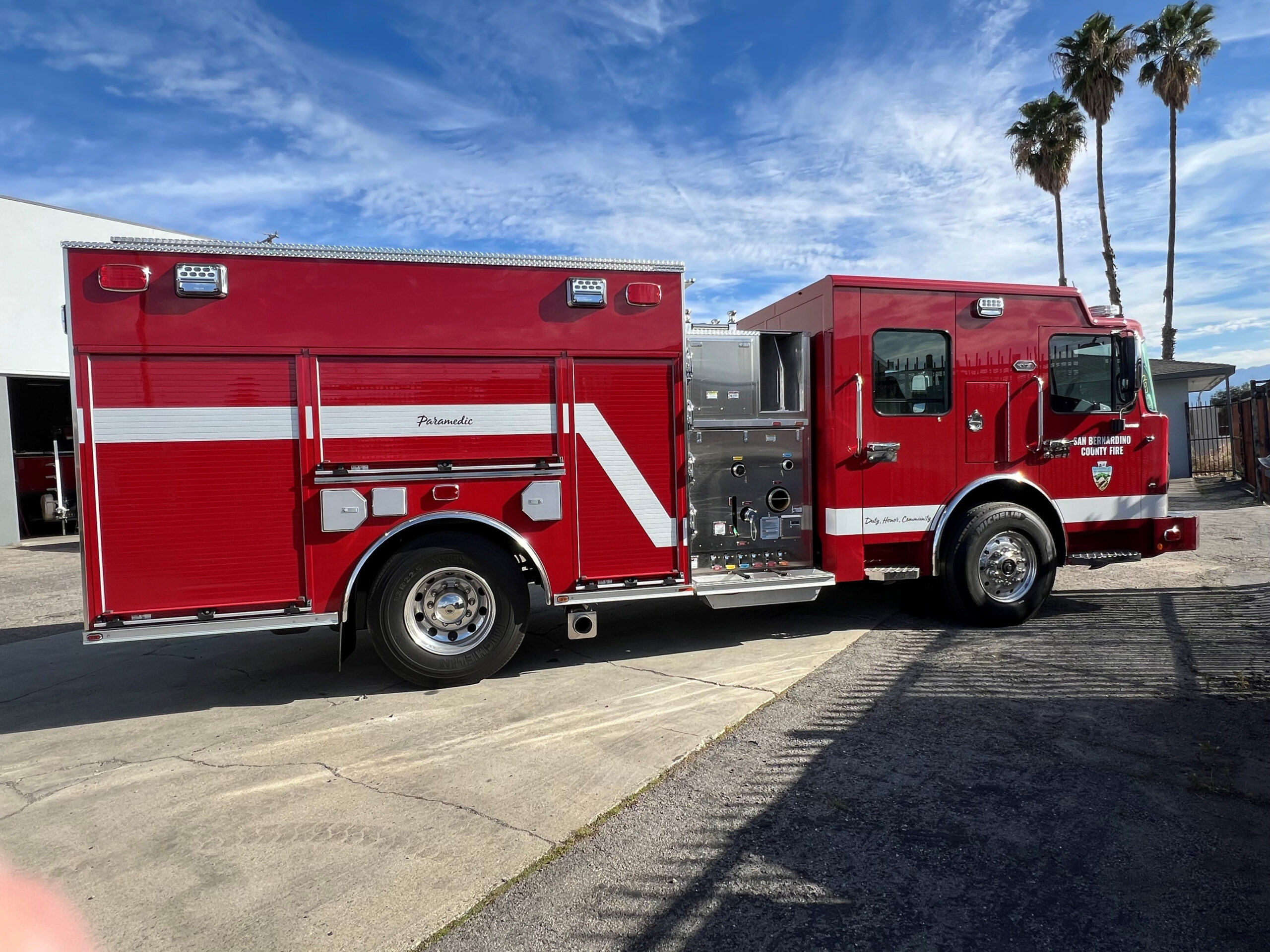
The West Coast pumpers have Tri-Max™ high-strength aluminum bodies on Vibra-Torque body mounting systems, ROM Series IV roll-up doors, high side compartments, and four coffin compartments.
Gomez points out the West Coast pumper has been a big hit in California. “Orange County has 24 on order and 14 are being delivered now,” he says. “[It’s] the same build as the San Bernardino County pumpers, only with a different seating configuration, but still with clean cabs and the SCBA in the L2 and R2 compartments.”
He adds that two K-180 West Coast pumpers are being built for the Ontario (CA) Fire Department, and two for the Rancho Cucamonga (CA) Fire Protection District, while the Alhambra (CA) Fire Department and the San Diego County (CA) Fire Protection District each have two rigs on order.
San Bernardino County (CA) Fire Protection District Strength: 1,039 full-time firefighters, 31 part-time firefighters, 388 other staff; 50 stations.
Service area: The San Bernardino County (CA) Fire Protection District provides fire, rescue, and specialty rescue response to a population of 2 million residents in 19,278 square miles encompassing 24 cities and unincorporated county land.
Other apparatus: Type 1 engines, Type 3 4×4 wildland urban interface (WUI) pumpers, tractor drawn aerials (TDAs), aerial ladders and platforms, water tenders, heavy rescues, hazmat trucks, command/communication support vehicles, snow cats, and dozers.
KME K-180 Pumpers
- KME Panther extended medium four door cabs and chassis with 10-inch raised roofs
- Seating for five firefighters in clean cab concept cabs with two EMS cabinets
- Hendrickson STEERTEK NXT front suspensions
- Waterous ESU 2,000-gpm pumps
- 500-gallon water tanks
- 20-gallon foam tanks
- FoamPro 2001 foam systems
ALAN M. PETRILLO is a Tucson, Arizona-based journalist who has served as a newspaper reporter, editor, and magazine writer and is a member of the Fire Apparatus & Emergency Equipment Advisory Board. He served 22 years with the Verdoy (NY) Fire Department, including in the position of chief.