BY KEVIN ROBERTS
When a water pump moves coolant through the cooling system it does not contribute primarily to the pressure in the system. That pressure comes from the heat of the coolant trying to expand inside a closed system. There is a slight pressure difference between the inlet to the water pump and the outlet from the water pump, but it is not significant.
When you pump up a tire, you use an external compressor to add air to the tire. The HVAC system is different. We are neither simply circulating refrigerant, nor are we making use of an external compressor to increase pressure. We are using the compressor as both the circulation pump and the source of pressure differential inside the system.
Since we need a significant pressure differential inside the system to take advantage of the principle of latent heat, we must either compress the refrigerant into a sealed section, or, if not sealed, we need a restriction tight enough to make a “high side” area between the compressor outlet and that restriction. If the passage in the restriction is small enough, the compressor can support the high side pressure while running. This is similar in principle to a resistance causing a voltage drop. The restriction serves as the load on the system. No restriction means an unimpeded flow of refrigerant (or electrons) and minimizes the type of work that can be done by the system.
Related Content
We commonly use a thermal expansion valve to serve as the restriction. Our goal is to compress vapor (gaseous refrigerant) against a restriction, condense it (into liquid) before it arrives at the restriction, and then use interior heat from the cabin to evaporate it again. This allows us to feed it back to the compressor without causing the compressor to self-destruct from liquid. If we kept the refrigerant as a vapor, we could circulate it without a restriction. If we kept the refrigerant as a liquid, we could use a pump, similar to a water pump, to circulate it. But to make it work as a refrigerant efficiently, we need to change it from vapor to liquid and back again.
So, let’s cover some definitions.
- Vapor: the gaseous state of refrigerant.
- Liquid: the condensed state of refrigerant.
- Static pressure: The normal pressure in the fixed volume system that comes from having the correct amount of refrigerant. This can be measured when the compressor is not running.
- Dynamic pressure: The pressure in the system when the compressor runs. The outlet of the compressor feeds the High Side. The inlet of the compressor is fed by the Low Side.
- High side: the section of the refrigeration cycle in which you have high pressure. Either as a vapor, exiting the compressor, or as a liquid exiting the condenser.
- Low side: the section of the refrigerant cycle in which you have low pressure. Either as a liquid-vapor mix, entering into the evaporator core, or as a vapor, coming out of the evaporator core.
- Thermal expansion valve: (TXV) This is a self-regulating, adjustable valve that meters the amount of refrigerant passing into evaporator.
- Superheat: This is a temperature. It is the number of degrees that a vapor is above the boiling point.
- Subcooling: This is also a temperature. It is the number of degrees a liquid is below the boiling point.
- Saturation Point: The specific temperature and pressure at which liquid and vapor coexist.
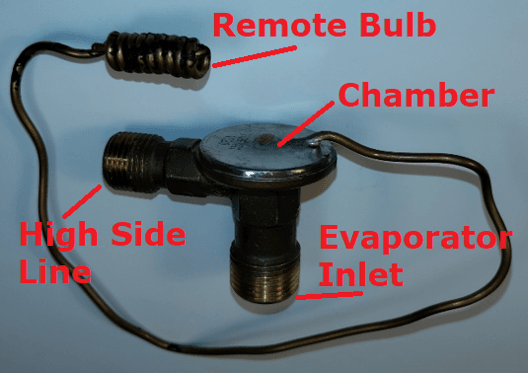
Figure 1
The TXV performs two tasks. First, it monitors the temperature of the evaporator core outlet. This is accomplished by a sealed chamber with a diaphragm that contains refrigerant either with a remote sensing bulb at the end of a narrow tube (figure 1) or by configuring the valve into an “H Block” that contains both the evaporator inlet and the outlet. (figure 2) As the outlet temperature changes, the refrigerant in the chamber expands. Second, it controls the amount of refrigerant entering the evaporator core inlet. The diaphragm is attached to a metering valve at the evaporator inlet port of the TXV. This makes the TXV both the input and the output of a feedback loop.
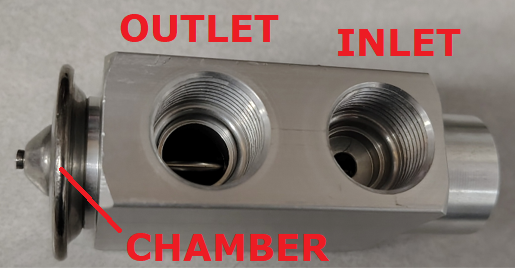
Figure 2
When viewed this way, the TXV can be understood to control evaporator outlet temperature. By controlling the flow of refrigerant and allowing only the amount of refrigerant through the evaporator that will allow the temperature at the outlet of the evaporator to increase, the system can prevent liquid refrigerant from entering the compressor. We do not want non-compressible liquids entering the compressor. They may internally self-destruct if this happens. This can also be described as controlling superheat. Since superheat is the number of degrees above the boiling point or saturation point, this number of degrees provides a buffer to prevent liquid from entering the compressor.
By efficiently performing these two tasks, the TXV balances the amount of refrigerant flowing internally through the evaporator with the variable amount of air flowing externally requested by the operator and, therefore, the amount of cooling in the passenger compartment.
So, how do they fail? By allowing either too much or too little refrigerant to enter the evaporator. This is where we will use what we know about superheat (at the evaporator outlet) and subcooling (at the condenser outlet). If we lose the proper restriction between the high side and low side of the circuit opposite the compressor, the evaporator gets flooded with refrigerant and you risk having liquid coming out of the evaporator outlet. This means no superheated vapor for the compressor to compress. If we over-restrict the flow into the evaporator, the superheat goes high, and the compressor may receive vapor hot enough to overheat the compressor.
Unfortunately, emergency vehicle TXVs do not (in my experience) commonly fail in this all-or-none fashion. They just seem to not quite balance the proper amount of refrigerant flow into the evaporator. This leads to improper and inefficient cooling. Next time: The refrigeration cycle.
KEVIN ROBERTS is the president of the Emergency Vehicle Technician Certification Commission (EVTCC).